
How do estate agents comply with Material Information rules?
Knowledge Hub · Upfront Information and Material Information
Last updated: 8 September 2026
Material Information compliance is no longer optional, and it is no longer enforced at arm’s length. Since 6 April 2025, the Digital Markets, Competition and Consumers Act 2024 has given the Competition and Markets Authority direct powers to investigate estate agents and impose financial penalties for non-disclosure without going to court. The question for agents is no longer whether Material Information matters, but how to build compliance into every listing from the outset.
This guide sets out the practical steps estate agents need to take to comply, the most common gaps that create risk, and how digital tools can reduce the burden. For a broader explanation of what Material Information is and why the law has changed, see our guide to Material Information under the DMCC Act.
What does compliance actually look like?
Material Information compliance comes down to four things: collect, verify, display and retain.
Collect means gathering the relevant property data before the listing goes live. Under the DMCC Act, a listing that omits material information is automatically an unfair commercial practice. The obligation is not to collect data by exchange; it is to have the data in the listing itself from day one. This includes financial essentials (price, tenure, council tax, service charges), physical characteristics (rooms, utilities, broadband, heating) and location or transaction factors (flood risk, planning, restrictive covenants, lease terms).
Verify means confirming the data against trusted sources rather than relying solely on seller declarations. Seller-provided information is a starting point, but verified data from Land Registry, local authority and environmental sources is the standard that reduces misrepresentation risk and strengthens the listing’s credibility with buyers and their lawyers.
Display means presenting the information in the listing itself, not in a follow-up document or a separate data room. The DMCC Act requires that the information be available to consumers at the point of the transactional decision, which in practice means on the portal listing, on the agent’s own website, and in any other marketing material.
Retain means keeping the information as part of the property record after the transaction completes. Under the RLBA standard for digital property logbooks, verified data is stored as part of the property’s property record, available for the next transaction without needing to be rebuilt. This is where Material Information compliance connects to the broader logbook principle.
Where agents most commonly fall short
National Trading Standards data suggests that only around 35 per cent of listings contained adequate Material Information at the time of the MHCLG consultation. Roughly 10 per cent did not include even the most basic data such as price and tenure. The most common gaps are:
Listings that include Part A data (price, tenure, council tax) but omit Part B (physical characteristics) and Part C (location and transaction factors). The three parts represent a spectrum of difficulty: Part A is straightforward, Part B requires more research, and Part C often requires searches or verified third-party data. Many agents stop at Part A because it is what portals require as a minimum.
Listings where material information is collected after marketing begins rather than before. Under the DMCC Act, the obligation attaches at the point of marketing, not at the point of offer. Retrofitting compliance after a listing goes live creates a window of regulatory risk.
Listings where data is seller-declared but not verified. Seller declarations are valuable, but a CMA investigation will assess whether the agent took reasonable steps to verify the information. Relying entirely on the seller’s word without any cross-referencing against official sources is a compliance gap.
The CMA enforcement reality
The CMA’s penalty regime is now live and the first fines have been imposed. In April 2026, the CMA fined the AA Driving School £4.2 million for unfair commercial practices in online booking, using its new direct enforcement powers under the DMCC Act. The case was unrelated to property, but it demonstrated two things: the CMA is willing to use its powers, and the timeline from investigation to fine is measured in months, not years.
For estate agents, the maximum penalties are fines of up to 10 per cent of global annual turnover or £300,000, whichever is greater. Directors face personal fines of up to £300,000. Criminal sanctions remain available for the most serious breaches.
What changes when the new guidance lands
There is a gap in the rules at the moment, and it is worth understanding because it changes what compliant means today. NTSELAT withdrew its Material Information Guidance on 9 May 2025, which removed the list without removing the duty. MHCLG then consulted on replacement guidance between 6 October and 29 December 2025.
In June 2026 the government published its Home Buying and Selling Reform Roadmap, confirming that further guidance on material information will follow later in 2026 and that sellers and agents will be expected to prepare a sales pack before a property is listed. The roadmap names digital property logbooks and digital sale packs directly.
The practical answer for agents has not changed. Keep working to Parts A, B and C, gather and verify at instruction rather than at offer, and choose a process that will survive the new guidance rather than one built for the old list. Our full analysis of the reform roadmap sets out what is coming and when.
How digital tools reduce the compliance burden
Manual collection of Material Information across Parts A, B and C is time consuming, inconsistent across offices and prone to error. This is why a growing number of firms are adopting platform-based approaches that automate the collection and verification process.
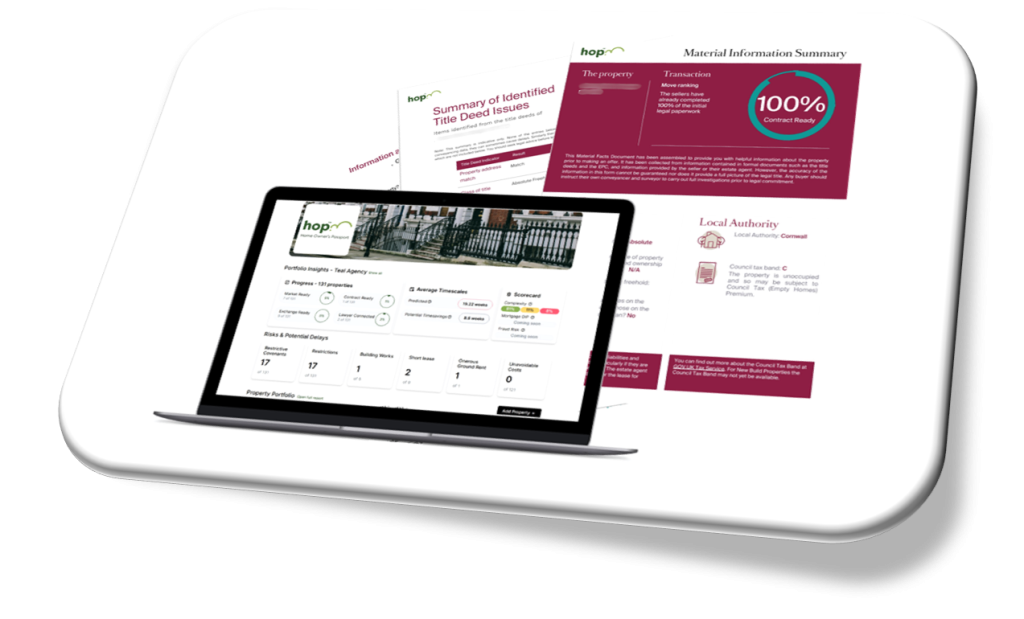
The hop platform gathers Material Information from verified sources (Land Registry, local authority, environmental and utilities data) and assembles it into a structured, compliant format at the point of instruction. Data is mapped to Law Society licensed forms and presented in a way that supports both the portal listing and the downstream conveyancing process. For agents, this means every listing is compliant from day one without manual effort on each individual property.
Because the data is retained as part of the property’s digital logbook, it does not need to be rebuilt for the next transaction. The agent who sponsors the logbook retains the client relationship, creating a commercial return that extends beyond the current sale.
Frequently asked questions
What is Material Information compliance?
Material Information compliance means collecting, verifying, displaying and retaining all property facts that could influence a buyer’s decision, and including them in the listing from the point of marketing. Under the DMCC Act 2024, failure to do so is automatically an unfair commercial practice.
Can I add Material Information after the listing goes live?
The DMCC Act obligation attaches at the point of marketing. Adding information later does not retrospectively remove the compliance risk for the period during which the listing was incomplete. Best practice is to gather and verify all Material Information before the property is listed.
What if the seller refuses to provide information?
Agents should document the request and the refusal, and verify what they can independently from official sources. The CMA will assess whether the agent took reasonable steps, not whether the seller cooperated. Digital tools that gather data from verified third-party sources reduce dependence on seller cooperation.
Get compliant from day one
The hop platform gathers and verifies Material Information at instruction, so every listing is compliant from the day it goes live. Start with a free Snapshot on your next valuation, or speak to us about Sale Packs and Logbooks across your branches.
This article is general information about the regulatory position and is not legal advice.