
How estate agents win more instructions with upfront information
Knowledge Hub · Estate Agents
Last updated: 8 September 2026
The valuation appointment is where instructions are won or lost. Every agent in the room is saying the same things: local knowledge, marketing reach, buyer database. The agent who walks in with verified property data, a Material Information report, and a clear plan for getting the listing compliant and live within 24 hours is the one who changes the conversation. That is how upfront information helps agents win more instructions.
This article explains why the listing conversation is changing, what sellers now expect, and how agents are using digital tools to differentiate at the point of instruction.
The trust deficit agents face
When a seller chooses between agents, trust is the deciding factor. Price guidance matters, marketing matters, but the seller’s fundamental question is: do I believe this agent will look after my interests? Agents who can demonstrate competence and transparency at the valuation, by showing verified data about the seller’s own property, answer that question before it is asked.
What sellers now expect
Seller expectations have shifted. The combination of Material Information regulation, portal transparency requirements, and a generation of sellers who research their own property online before inviting an agent means the valuation appointment is no longer a blank-sheet conversation. Sellers arrive informed, and they expect the agent to be more informed than they are.
Agents who turn up with a printed valuation letter and a fee proposal are competing on price alone. Agents who turn up with a Valuation Ready report showing Land Registry data, complexity scoring, planning history, flood risk and a clear timeline to listing are competing on capability. The instruction rate difference between those two approaches is measurable.
How upfront information wins at the valuation
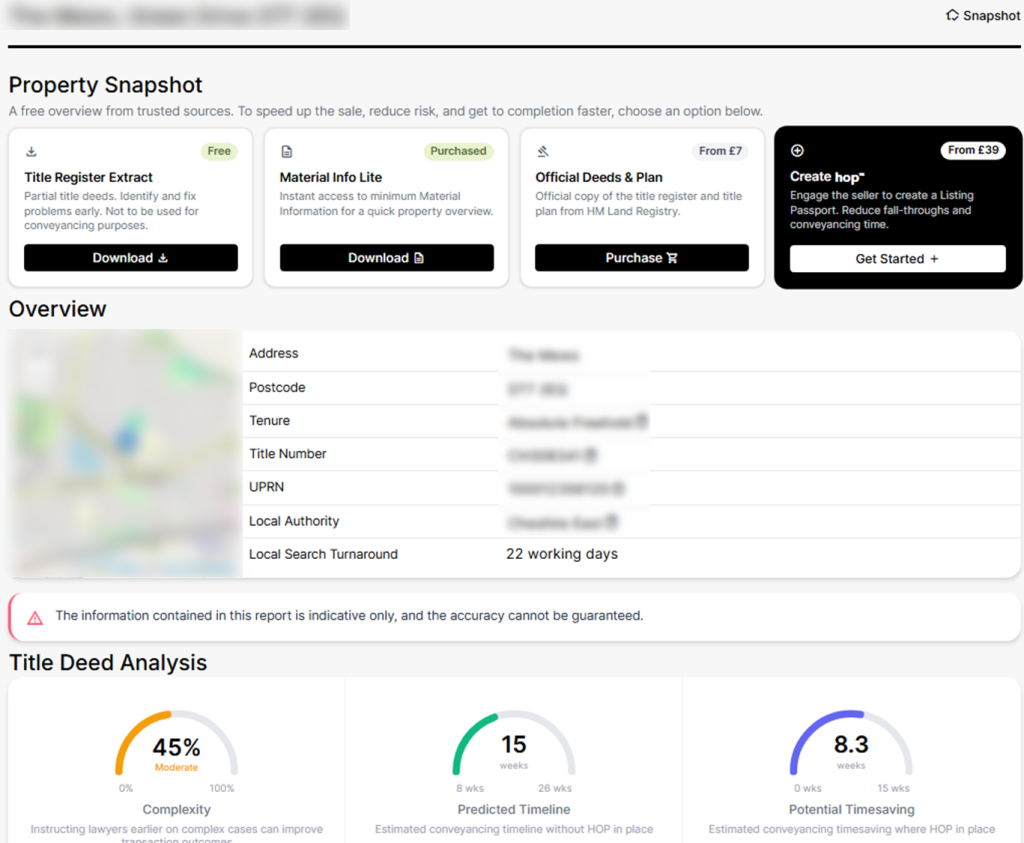
The practical mechanism is straightforward. Before the valuation appointment, the agent runs a Valuation Ready search on the property using verified data from Land Registry and other official sources. This generates a property intelligence snapshot covering title, tenure, complexity indicators, and any issues that could affect the transaction timeline.
At the appointment, the agent presents this snapshot alongside the valuation itself. The seller sees three things immediately: the agent already knows the property, the agent has identified any issues that could slow the sale, and the agent has a plan to address them before marketing begins. This is a fundamentally different conversation from the traditional pitch.
The commercial impact is direct. Agents report that presenting verified property data at the valuation appointment accelerates the seller’s decision, reduces the number of competitive pitches the seller seeks, and positions the agent as the professional choice rather than the cheapest option.
Speed to market as a competitive advantage
Sellers care about speed. The longer a property sits unlisted while information is gathered, the more anxious the seller becomes and the more likely they are to question whether they chose the right agent. Upfront information compresses the timeline from instruction to listing.
With Material Information collected and verified at the point of instruction rather than weeks later, the property can go live on portals within 24 hours. This is not a theoretical claim; it is the operational reality for agents using digital platforms that automate the collection process. Industry trials referenced in the MHCLG consultation suggest that having key information available earlier can speed up transactions by four weeks.
For the agent, speed to market means the seller sees results immediately, the marketing window opens sooner, and the pipeline moves faster. For the buyer, it means the listing contains verified information from day one, reducing the risk of surprises during conveyancing that cause transactions to fall through.
Reducing fall-throughs to protect commission
Roughly one in three UK property transactions fails to complete. Every fall-through represents wasted time, lost commission, and a frustrated client who may not relist with the same agent. The single biggest driver of fall-throughs is information that emerges late in the process: title issues, lease problems, planning restrictions, or disputes that could have been identified and disclosed upfront.
Material Information that is gathered and verified before marketing begins surfaces these issues at the point of instruction, not at the point of exchange. Problems that are known and disclosed are manageable. Problems that emerge after an offer has been accepted are the ones that kill transactions.
For agents, this is a direct commercial argument: upfront information protects the pipeline. For sellers, it is a trust argument: the agent who identifies a potential issue before marketing and has a plan to manage it is the agent the seller wants handling their sale.
The Property Logbook as a retention tool
Winning the instruction is the beginning, not the end. Most agents lose contact with a client the moment the sale completes. The property data gathered during the transaction disappears into the conveyancer’s file and the relationship ends.
A digital Property Logbook changes this dynamic. When the agent sponsors a logbook for the client’s property, the verified data from the transaction is retained as the record of that home for as long as your client owns it. Every title change, every planning notification, every environmental update arrives under the agent’s brand. When the client is ready to move again, the agent is the first call, not one of three agents invited to re-pitch.
This is the principle behind the hopLogbook: one property, one logbook, one ongoing client relationship. The agent who wins the instruction and delivers the logbook retains the client beyond the transaction.
Frequently asked questions
How does upfront information help agents win more instructions?
By presenting verified property data at the valuation appointment, agents demonstrate competence, transparency and speed. Sellers see that the agent already knows the property and has a plan for getting it to market quickly and compliantly. This changes the conversation from price to capability.
What is a Valuation Ready report?
A Valuation Ready report is a property intelligence snapshot generated from verified sources including Land Registry, local authority and environmental data. It covers title, tenure, complexity indicators and potential transaction risks, and is available within minutes of the agent running the search.
How does the Property Logbook help agents retain clients?
When the agent sponsors a logbook for the client’s property, verified data from the transaction is retained under the agent’s brand for as long as the client owns the home. Ongoing alerts and updates keep the agent visible to the client long after the sale completes, positioning them as the first call for the next move.
Win the instruction with verified data
The hop platform gives estate agents verified property intelligence from the point of valuation through to completion and beyond. Speak to our team about hop Snapshots, hop Sale Packs and hop Logbooks for your firm.
This article is general information and is not legal advice.